Showing posts with label cyber-community. Show all posts

3/11/13

The car abets obesity / The girth is there for all to see


The car abets obesity
The girth is there for all to see
There is but one clarion call
Cars should be peripheral

+

If this appeals, 
you might check out 
Pattern Language thoughts at

Stephen's Remarkable Kindle Store
Follow Me on Pinterest


Buffer

1/19/13

Think of Making Business Come to You


My headline is speculative but suggestive
It suggests we - workers - creators - skilled ones - etc.
could turn the tables on the entire control
KochWorld now exerts over everyone
Simply insist we work where we live
The employer must locate 
a portion of business where we are
or we work remotely from home 
or a nearby workplace away from our private space
More and more of us
will prefer an urban car-free environment 
(where vehicles are limited to the periphery)
with everything is within walking or jogging distance
It will become cheaper and vastly more integral
to work remotely 
It beats living in a sprawl-burb
having cars for every member of the family
and commuting your life away
If you want to think of a new economy
where workers actually have some leverage
think of creating a union of all workers
who insist on working remotely
Think of making business come to you

Stephen's Remarkable Kindle Store 
Follow Me on Pinterest


Buffer

1/18/13

Open Source Economics can work in the US under current law


Open Source Economics can work in the US 
Cyber-Communities
can and should be incorporated as not for profit
They do not replace the current economy
They enable the expansion of the Open Source model

Like-minded persons should
create models of communities
sponsor creation of plans and designs
and
actually build communities
using pre-made components such as 
standard surfaces 
sound-proof walls
a matrix made up of modular components
 
The iteration of
these efforts
can be hugely profitable via 
licensing arrangements
royalties and fees

Community that is integral needs to 
sieze current imagination
An integral Cyber Community
is the car-free
celebration of the coming megalopolis
This is a the major business frontier of this century

Stephen's Remarkable Kindle Store 

Follow Me on Pinterest


Buffer

11/21/12

Dear Jeff Bezos, here's your big idea. You can do this.


Jeff Bezos - Forbes http://buff.ly/Y2ja8R

+

Jeff you told Charlie Rose you wanted to do something
no one else has done
Alright
Do this

+

Hire a team to design a prototype of
what I have called a cyber-community
A diverse multi-purpose community 
of around 10K persons  
car-free 
with urban amenities 
where one lives and works and recreates. 
The design should have the following components
The community should be compact 
no more than a mile from side to side
It should have no stairs
and no more than four levels
It should be built to withstand flood
fire and extreme weather
It should generate and distribute 
the bulk of its own energy
It should collect much of its energy 
in the form of wind and sun
It  should be prefabricated
Its surfaces and walls
should be smart and dupllicable
and easily replaceable
A cyber community
of this sort would have
residences and work spaces
and all the public and commercial
elements we associate with urban life
scaled to the needs of the particular community
Stores would be cyber-kiosks 
where one could access all products
on a large screen
and order them for delivery
Public facilities would be used in common
There would be a public square every 100 yards or so

+

Once you get the design and build a model
you will be able to market this as
the wave of an ecologically sane future
When you build your next data center
build one of these

+

There is much more on cyber-communities
on this little blog
Believe me Jeff
the person who makes
properly-scaled
integral sustainable living
normative
will have
opened the door to a viable future

+

Stephen's Remarkable Kindle Store

Follow Me on Pinterest

11/10/12

My Progressive Proposal Par Excellence Time for A Mass Migration


Election Data Dive - NYTimes.com: " Romney also won eight of the 10 states with the lowest population density: Alaska, Wyoming, Montana, North Dakota, South Dakota, Idaho, Nebraska and Utah. "

'via Blog this'

Every one of my posts is an introduction to this blog which is an introduction to angles of visions shared by many but realized by few.

Part of the problem is one of expression, my own. I know what I want to see but I cannot draw it or even describe it very well.

But it is the solution in almost every area - politics, society whatever.

So here is a chunk. We could profit massively from a mass migration.

We do not need to be in this or that city. With a bit of brain power we could create the cells of urban living anywhere at all.

So go to the states where Romney won. Buy up defunct towns. Build new car-free cities on high enough ground that they will not flood when it rains.

We can solve the problem of polarization and social injustice by making residence voluntary and building in diversity from the gitgo.

Communities would have populations of 5-10K and everything within a walk of up to a mile.

Communities would be car free.

Construction would be cyber-eco past the clunkiness of most comtemporary construction.

This will revolutionize the whole world because it will involve applying smarts to human settlements and introduce community safety and weather-resistance into the discussion ,

Oh, and ...

Once we have the majority in these states we can sleep better on election night.


Stephen's Remarkable Kindle Store

Follow Me on Pinterest

6/11/12

Has the computer reduced chldhood to dross


The Original Playstation is quite obviously 
a call to reconsider the option available to children
in today's world
where the dawning Cyber Age  
gradually impacts the waning Industrial Age
The notion that we will have no outside play
assumes that the Industrial Automobile Sprawl Koch Age
is still dominant
The reality is that everything is being transformed
from the smallest to the largest
What we call the environment will be the last
When that transformation comes we will 
no longer be a consumer culture
lost in sprawl
Our environment will enable the creation of
Cyber-Community


My Kindle Store Books

5/22/12

Cyber-community 101 - Lesson Three


 A cyber-community must be dense enough
to enable growth of a viable local economy

Why is this so

In the United States we suffer from 
too much dispersion in rural areas
No local economy can thrive there

In our metro areas
a combination of zoning
and concentration
inhibits the growth of natural
economies

A reasonable density for a viable local 
economy
is between 5,000 and 10,000
Such populations can support
local versions of
commercial
residential
cultural
educational
health
and recreational
facilities

These can be staffed by local people

A viable local economy will need in the future
to generate its own energy
When a community is dense enough 
and is free of most or all automobile traffic
it can develop new ways of
energy generation
even including energy generated by
human activity
and human interaction with
such things as
turbines 
and pendulums
developed for fitness
and play purposes

In the future people will choose diversity
characteristic of cities
in preference to monochromatic
stratified sprawl existence

Communities as envisioned here 
can exist in close proximity


My Kindle Store Books

4/27/12

Twelve Reasons Romney is Going Down as We Speak


Surrounded by neo-cons who counsel war
Tied to Rove and the Koch Brothers 
Identified with Bork and overturning Rowe v Wade  
Health care conundrum
Foreign policy flops
Horrendous media advice
Tepid and borderline endorsements
No honeymoon bounce
Past statements come home to roost
No place to pivot to 
The GOP Congress
On all accounts an undesirable risk


 People's solution - 
Democratic majorities in Congress 
Re-election of the President
Progressive solution - 
Think beyond oil and sprawl and how 
a commitment to that could revolutionize 
our economy and politics
Consider how election of Romney would 
set things back 

4/6/12

Cyber-Community Broadside Number One

10K persons diverse in every way living 
in an area made car free
Sharing a common structure for eco-sustainability
beyond the reach of any individual to afford

Having within walking distance education
health recreation dwellings commercial ventures
squares small play grounds 
A public space
as attracting to people as private spaces


Click to enlarge


Charles Sanders Peirce - Thinking in Threes

What is a cyber-enabled car-free community?


10K persons diverse in every way living 
in an area made car free
Sharing a common structure for eco-sustainability
beyond the reach of any individual to afford

Having within walking distance education
health recreation dwellings commercial ventures
squares small play grounds 
A public space
as attracting to people as private spaces

Dwellings and all other structures
made of modular mass-produced elements
including smart walls and other surfaces
built-in structures for furniture and work sspaces 
in a safe and cord-free 
environment
In a cyber-community most present 
education and commerce runs out of
kiosk-like small facilities 
that are open much of the time
Education would be at once freer
and more interactive
Everything would be

Current institutions would adapt to the new form
but have functions similar to existing functions
People would live and work in the cyber-community
Most elements of the global culture would be 
available to all in an adaptation of today's 
sports bars

Cyber-communities can spring up
anywhere and become safe  face to face
environments for persons who live by
the shared values of democracy
helpfulness tolerance and non-idolatry

A  cyber-community is not a utopia
It is a grass-roots democracy that
runs as most town governments do

Moving beyond oil, detached sprawl
housing and cars is inevitable because
it creates a system that cannot be 
afforded in the future 
while doing nothing to make society 
more fulfilling

For more please click the 
cyber-community label below


Charles Sanders Peirce - Thinking in Threes

Neither Party Understands the Economy

The economy will not recover 
Because the car industry was saved
The economy will not recover
Because there is an uptick in housing purchases or construction
The economy will not recover because either party
now has the policies to lead it toward new prosperity
Stasis and sclerosis will endure while both parties
compound delay by arguing for mutually wrong premises
You ask what is the right course
Simply this
Concede that the triumvirate of sprawl
oil dominance and the related businesses 
is anemic and a recipe for a century of
sclerosis war and untold poverty
Concede that a properly densified society
with communities of around 10K
Zoned for everything needed  to live
Car free 
Built on modular principles 
with a shared-ecostructure
Is the right track
Concede that the correct approach is outlined here
under the label cyber-community
The future must be sprawl free
Car free
Face to face community
Enabled by cyber-means
That nobody who should have seen this saw it
is cause for some skepticism that this simple answer
will be known in time to make a difference 


Charles Sanders Peirce - Thinking in Threes

3/31/12

Why Cyber-Communities Will Replace Sprawl


Linking logic and emotion is a start
Linking these to a third makes for progress
Logic - cheaper and better to exchange 
the oil-automobile (failing) economy 
for the cyber-community economy
Emotion - in two decades the young have begun to pull away 
from the car-suburb (faux) American Dream
Because Cyber-Community is more rewarding
and vastly more affordable
The third to which these two link is
the hypothesis
Cyber-Communities will replace sprawl
and with it the oil-car economy
Oil and car will be replaced by
Modular elements needed to
Revolutionize construction so that
Most of the toxic elements of say the Koch Brothers portfolio
Will be unnecessary
In short the car free cyber-community
everything-within-walking-distance model
Can and will spring up on the dessicated
corpses of sprawl elements like malls
Houses will be replaced by mass-produced smart walls
Energy-yielding floors and flexible ceilings
The lego-type elements of the future
Staffed and focused specialized cyber-kiosks will replace strip malls
So forth 
So on
By choice or inevitably
Were I 25 not 75 I would go into business


Charles Sanders Peirce - Thinking in Threes

3/13/12

Help make cyber-community a reality.

Cyber community is my term for what I believe is an entirely new concept for the reformulation of how the world lives. A cyber-community has a general limit of around 10,000 people. Enough for a vibrant local economy. A cyber community is car free, compressed enough to have most social and many wider needs met within a walk of no more than a mile. It is low rise - a max of around four levels. It begs for architectural and design imagination, eco-vision and awareness of how today's society has become dysfunctional due to a lack of face to face community and social stratification. You live, work and play in a cyber community. Quite obviously you also solve the warming problem at the root, by eliminating the necessity for cars. Help make cyber-community a reality.


Charles Sanders Peirce - Thinking in Threes

3/9/12

Krugman is the most almost-right writer in the universe

Krugman because is almost right all the time. He is right in blaming the GOP for its criminal performance.

But he is very wrong on most economic questions for a very simple reason.

We have committed ourselves to a social matrix that is inherently unable to survive in its present form. There can be no recovery of education, of housing, of transportation. Each of these is part of the problem, not an answer.  All of these enterprises are predicated on the "self-evident" of continuing automobile use, continued need for stand-alone houses and continued capacity to afford and benefit from the educational system that we have.

The solution lies in a transition to concentrations of population that can generate bottom-up economies, a recalibration of enterprise so it can serve car-free cyber-communities of up to 10K persons each. These communities would be zoned for everything and essentially emulate cities of the past that were self-enclosed. All current institutions would be resized to serve the cyber-community and thus provide employment to its residents.

Cyber-communities could and would operate at roughly half the expense of maintaining our sprawl society. Cyber-communities would be able to afford eco-sustainability. They would be culturally alive. They would be diverse.

Krugman joins many public intellectuals in rejecting the need for a social sea change. We have had no discussion of these matters since the 1960s when four bullets stopped all discussion for more a half-century.


Charles Sanders Peirce - Thinking in Threes

3/8/12

Regions of between 2 and 10 million are an ideal basis for governance


Regions of  between 2 and 10 million are an ideal basis for governance but we can only think in terms of taking the populations we have and doing what we can to observe this rule in our creation of a new world of car free communities.  The fundamental argument for such population math is economic.

Without a region in which at least 2 million live and move and have their being, we are condemned either to gross congestion or the atrophy of too few people to sustain the basic elements of living.

What my notion of cyber-communities and cyber-cities does is build from the bottom up toward such a regional concept. A cyber-community of up to 10,000 persons can be built from the existing settlements and eventually replace them. These can be connected by yet-to-be invented evolutions of buses and trains - public transit. All communities will be walkable. A cluster of 10 cyber-communities would nest within a larger region containing 100 cyber-communities. A region could consist of from two to ten such nested elements.

Human governance needs to be accessable to communities that are themselves intelligible as living areas. A cyber-community is such a unit. Ten such suggest a reasonable city size.Individual communities would contain a few of the larger structures. Many presently large structures would be be scaled down to function in the cyber-communities. For example a cyber-community would have infirmaries but a hospital would exist to serve ten cyber-communities.

Because cyber communities would be global and trump distances by means of technology there is no reason why, in a nation like the United States, such communities could not be created de-novo anywhere.

Elsewhere I have suggested that interstates be the likely locations for cyber communities.

Charles Sanders Peirce - Thinking in Threes

We lack anything close to an ideal distribution of communities and population


All one needs to do is look at this map to see that we lack anything close to an ideal distribution of communities and population. We are behind the 8-ball economically and this is partly due to population densities. It takes around 10K human beings living in proximity to enable the natural growth of occupations and professions that make for a vital community. I have advocated that the interstate grid be used as the transport matrix for walkable communities of up to 10,000 (I call them cyber-communities) clustered in groups of up to ten to create cyber-cities of 100,000 separated by green space devoted to recreation and agriculture.

A cyber-metropolis would be a regional cluster of ten or so cyber-cities.

The genius of this scheme is that a walkable, car-free community can be built in an area a mile square, a miniscule amount of space. A population of 100,000 could be served by an aggregate of  just ten cyber-communities. Creation along these lines would revolutionize manufacturing because the components would all represent new inventions and designs, from the matrix needed to make each cyber-community ecologically sustainable to the mass-produced but customized  elements of  structures and spaces within the cyber-community.

How do we begin to take what we have now, subservient to the car and oil, and morph it into cyber-communities?. We do it first by creating cyber-communities de novo, from scratch. When we find a gutsy entrepreneur who is tired of gadget-capitalism, the fun can begin.


Charles Sanders Peirce - Thinking in Threes

3/7/12

Imagining Cyber-Communities


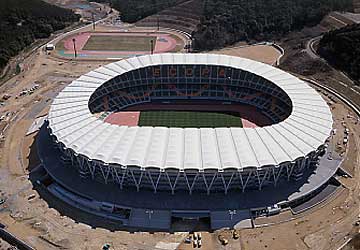
Some see a sort of competition between residential areas and countryside when it comes to the "best land". The glorious reality of my cyber-communities is that they could be built on landfill and they would still work. All a cyber community needs is a square mile. Depending on the political state of affairs, it will either be built with serious security in mind or with a degree of openness to the surrounding countryside - or more likely the surrounding sprawl or sprawl residue.

The setting of a cyber community should defer to the availability of lovely land to surround it. It can occupy a declivity, a valley, anything that suggests a degree of protection, since we would wish a cyber-community to withstand most extreme weather without a whimper. That said, we do not build cyber communities next to water or in tornado alleys or anywhere else that extreme weather is predictable. And if and when we build them our suggestive existing model for such a community is a stadium-like structure which may even have a retractable roof or some equivalent both to protect one from deluge and to capture the precious falling drops and process them for human use.


photo

The image above is not my idea of anything but the general
size and heft of a cyber-community. It suggests a matrix
which holds and supports the modular elements which
enclose spaces within the community. It suggests the height,
the walkability within its precincts, And one can readily
infer that 5000-10,000 could live in such spaces and have
plenty of room for other spaces and areas which would
provide any community anywhere with all the institutions
and amenities we associate with urbanity, with the city.
 

Charles Sanders Peirce - Thinking in Threes

A reason why Pattern Language (the book) is ignored


I think one reason Pattern Language (the book) is ignored is that it is predicated on the continued domination of the car. It assumes we will be driving forever. Thus when Alexander dismisses the suburb, he does not take the step of going back and admitting that Frank Lloyd Wright was wrong in assuming suburbanites would all have their own veggie gardens, responsibly turning the suburbs into a sort of nuclear family utopia, while at the same time drawing lovely interchanges and inadvertently, perhaps, suggesting the coming invasion of the cars. Alexander and Wright fell to the blandishments of the car. The sort of erroneous distortion of reality that surfaces in the noxious Ram ads now invading TV.  The beauteous countryside has an able partner -- Ram! Think the worst.

If you believe, as I have for fifty years, that the car is not a necessity but a choice, and that it became a necessity only because that was the easy route for capitalism, and that the car and suburb (sprawl) are  now revealed for what they are, then you will find it hard to accept Alexander's notions about country roads enclosing mile square areas and towns of up to 10,000 springing up de novo presently rural areas.

Had Alexander taken the bull by the horns and assumed the crying need for car-free communities, and anticipated the technology that would make the rebuilding of the world not only possible but a good idea,
he might have taken a simple page from Doxiadis and accepted the natural tendency of people to gather at intersections.

Gathering at intersections is why my front yard (the intersection of Broadway, Sizth Avenue and 34th Street is at times the most crowded in NYC. And why we have metropolises. The cyber-community, the car free zoned for everything evolution of the human settlement, is the natural result of putting together the impossibility of sprawl and the inevitability of concentrations of population.

Charles Sanders Peirce - Thinking in Threes

Economy is living with the least amount of unnecessary expense


Economy is living with the least amount of unnecessary expense. Cars, sprawl housing and oil represent an increasingly unbearable expense. Living car-free would enable creation of cyber-communities of up to 10,000 living within walking distance in neighborhoods zoned for all purposes. One would live and work and play in or near home. The more public space is made attractive and usable the oless need there is for all the rooms we msay nwe need in a home. The way is paved for mass-produced cyber-spaces which can become the modular elements of a cyber-community. Eventually this could replace the automobile business. Our present way of life is senseless and unaffordable. Safer options exist that are cheaper and more fufilling. 

Charles Sanders Peirce - Thinking in Threes

RECCMENDATION Richard Gordon Quantum Touch

The Slow as Molasses Press